
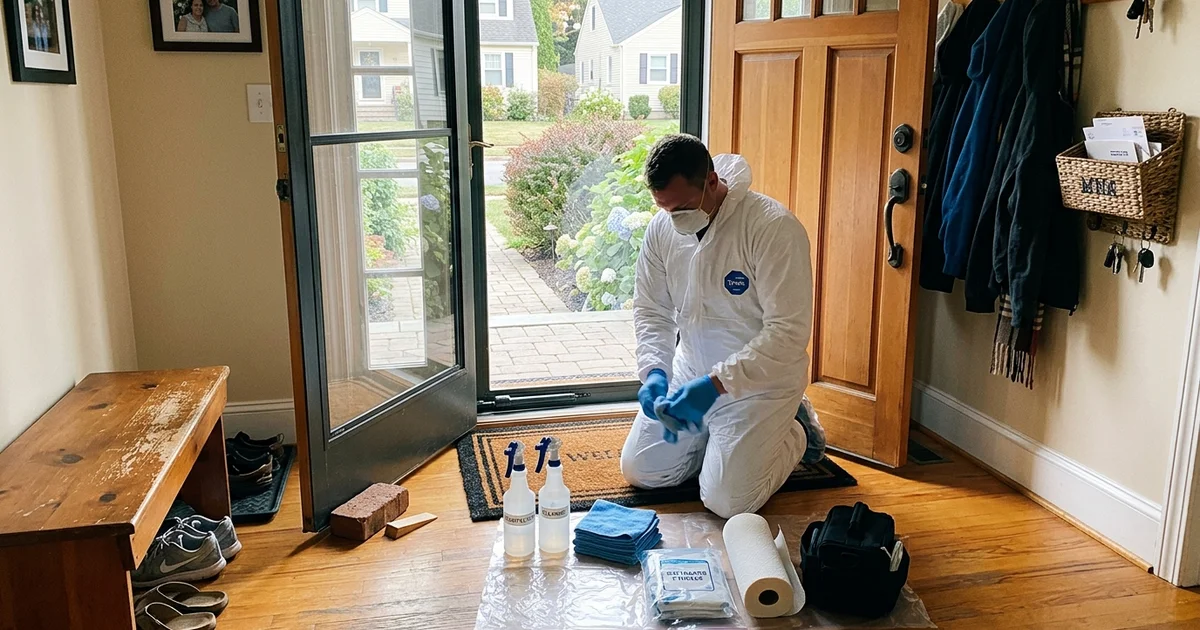
What crime scene cleanup actually means
Crime scene cleanup, also called biohazard remediation or bio-recovery, is the certified removal, decontamination, and disposal of blood, bodily fluids, and other biological hazards left behind after a homicide, suicide, unattended death, serious accident, or medical event such as a gastrointestinal bleed.
It is a regulated trade rather than a cleaning service. The people who do it properly work under the OSHA Bloodborne Pathogens Standard, hold HAZWOPER certification, carry specific insurance, and dispose of what they remove as Regulated Medical Waste with a manifest. If you are reading this because something has happened at your property, the work you need is Crime Scene & Biohazard Cleanup, and it is not something a general cleaning company is equipped or permitted to do.
The one thing nobody warns you about
When the investigation ends, the scene is released back to the property owner exactly as it is. No agency cleans it. That responsibility, and the decision about who handles it, lands on the family.
Why police and EMS release the scene but do not clean it
This is the single most common surprise in this work, and it catches people at the worst possible moment.
Law enforcement’s role is to secure the scene, gather evidence, and complete the investigation. The medical examiner’s role is to take custody of the decedent and determine cause of death. Emergency services attend to anyone who can be helped. None of those roles include remediation, and none of the agencies involved are funded or equipped to perform it.
Once the investigating agency has what it needs, the property is released to the owner or the next of kin. At that point the scene is a private property matter. In Cuyahoga County that release is coordinated between the responding agency and the Medical Examiner’s Office, and a remediation company can begin as soon as it happens. We routinely make that call on a family’s behalf so they do not have to.
Why ordinary cleaning cannot address it
There are three reasons, and each one matters independently.
Pathogens. Blood and bodily fluids can carry bloodborne pathogens including Hepatitis B, Hepatitis C, HIV, MRSA, and C. difficile. Household disinfectants are not rated against all of these, and surface application does nothing about what has soaked below.
Porous materials. Fluids move through carpet into padding, through padding into plywood or plank subfloor, and in extended cases into the joist cavity. Porous material cannot be reliably decontaminated. It has to be removed, disposed of correctly, and the substrate underneath treated and sealed.
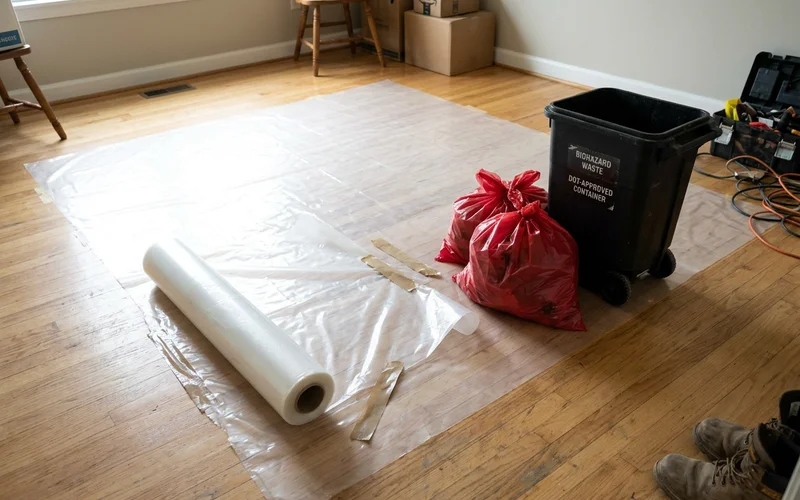
Disposal law. Material contaminated with human blood or bodily fluids is Regulated Medical Waste. It cannot lawfully go into a household bin or a skip. It is bagged in biohazard red bags, placed in DOT-approved containers, manifested, and transported to a licensed disposal facility. Getting this wrong carries real legal exposure.
What a certified crew actually does
The sequence is consistent regardless of the type of incident.
| Stage | What happens |
|---|---|
| Assessment | Map contamination, including what has reached subfloor, and produce a written estimate |
| Containment | Seal the affected area and run HEPA negative air so nothing migrates |
| Removal | Extract fluids and remove contaminated porous materials as Regulated Medical Waste |
| Disinfection | Treat all non-porous surfaces with EPA-registered hospital-grade virucide |
| Restoration | Treat and seal subfloor with antimicrobial primer where fluids penetrated |
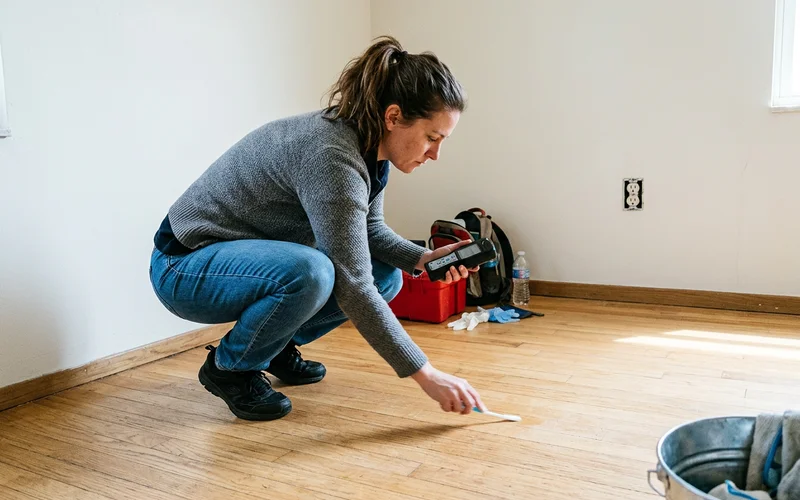
| Verification | ATP fluorometer surface testing to confirm decontamination, with documented results |
That last stage is worth pausing on. ATP testing swabs a cleaned surface and returns a numeric reading of residual organic material. It is how a professional proves the space is safe rather than asking you to accept a visual inspection. If you are comparing companies, ask whether they verify, and ask to see the results.
Who handles it, and how to choose
Look for OSHA Bloodborne Pathogens compliance, HAZWOPER certification, proof of insurance, and a written estimate before any work begins. Be cautious with any company that quotes a firm price over the phone without seeing photographs, and be very cautious with any that pressures you to sign the same day. This industry has a history of taking advantage of people during the worst week of their lives, and pressure is the reliable warning sign.
It is also reasonable to ask what happens if the crew finds more contamination than the estimate covered. The right answer is that they stop, tell you, and get written approval before continuing.
If you want to understand the underlying health risk in more detail, our guide on whether blood is a biohazard covers the specific pathogens involved and why DIY cleanup carries real exposure.
Nobody plans to need this information. If you are reading it today because something has happened, call us at any hour. There is no charge to ask a question, and we will tell you plainly what the situation requires even if the answer is that you do not need us.