
Why this is a different job
An unattended death requires far more than surface cleaning, and understanding why makes every other decision easier.
When a person passes alone and is not discovered for days or weeks, human decomposition remediation becomes a structural problem. Fluids move downward and outward through carpet, into padding, into plywood or plank subfloor, and in extended cases into the joist cavity. Odor molecules bind into every absorbent material in the space including drywall, insulation, and soft furnishings.
Nothing applied to a surface reaches any of that. This is why Unattended Death Cleanup is a specialist trade rather than an intensive clean, and why the sequence below cannot be shortened without the result failing.
Step 1: The call and scene release
We answer 24 hours a day. All we need initially is an address and a rough situation.
Where police or the Cuyahoga County Medical Examiner’s Office are involved, they control access until their work is complete. We coordinate release timing directly with the agency rather than asking a family to chase it, and we mobilize as soon as the property is released.
If you are a landlord or a property manager, the same applies. You cannot enter the unit until release either.
Step 2: Assessment of true extent
This is the step that separates a reliable estimate from one that doubles.
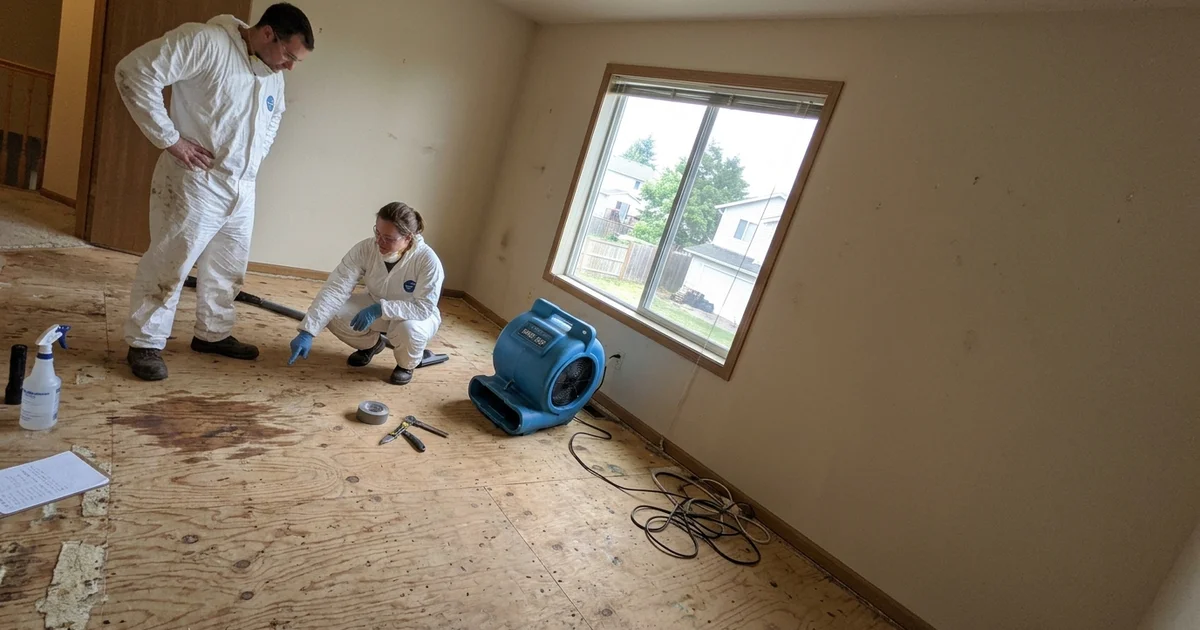
Our technicians map how far fluids have travelled, not how far they appear to have travelled. That means lifting flooring at the perimeter of the visible area, checking the subfloor condition, and where necessary inspecting the joist cavity below. In multi-unit buildings we assess the adjacent unit too, because shared subfloor and basement cavities carry both fluids and odor.
The written estimate that follows is itemized, and it states plainly where conditions may change once material is removed. If we find more than the assessment could see, we stop, tell you, and get written approval before continuing.
Time is the single largest cost driver
Contamination continues moving for as long as the property sits. The same scene routinely costs substantially more after two weeks than after two days. That is not anyone’s fault, and we say it only so nobody chooses to wait without knowing.
Step 3: Containment
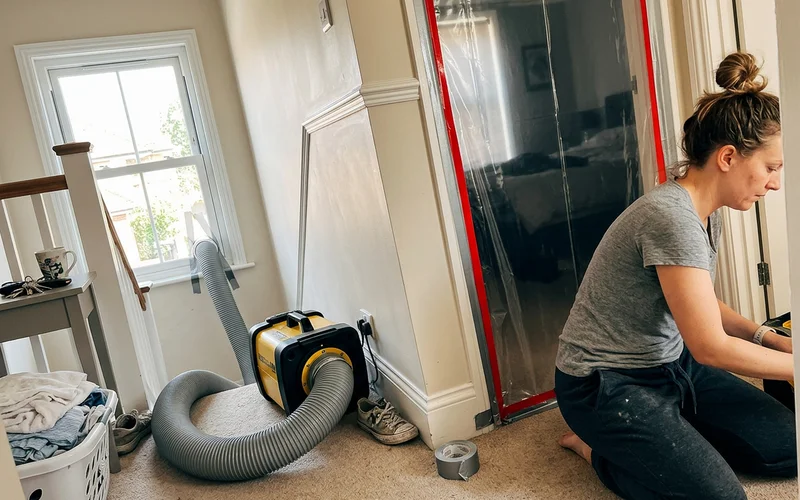
Plastic sheeting seals the affected area at doorways and openings. HEPA negative air machines run inside, keeping the work zone at lower pressure than the rest of the property so airborne contamination and odor cannot migrate outward.
In apartment buildings this also means sealing shared vents and coordinating with building management. Neighbours in occupied units should not be aware the work is happening beyond seeing a van.
Step 4: Removal and disposal
Fluids and tissue are removed first. Contaminated porous materials follow: carpet, padding, flooring, upholstered furniture, mattresses, and sections of drywall where penetration occurred.
Everything removed is bagged in biohazard red bags, placed in DOT-approved containers, manifested, and transported to a licensed Regulated Medical Waste facility. Chain of custody documentation is part of your closing file.
Step 5: Subfloor and structural remediation
This is the step that decides whether the result holds.
The exposed substrate is treated with a bio-enzymatic cleaner, which breaks down residual organic compounds at a molecular level rather than washing the surface. Where saturation has gone through the material, the subfloor section is cut out and removed. Where it can be treated, it is sealed with an antimicrobial primer sealant that locks down anything remaining.
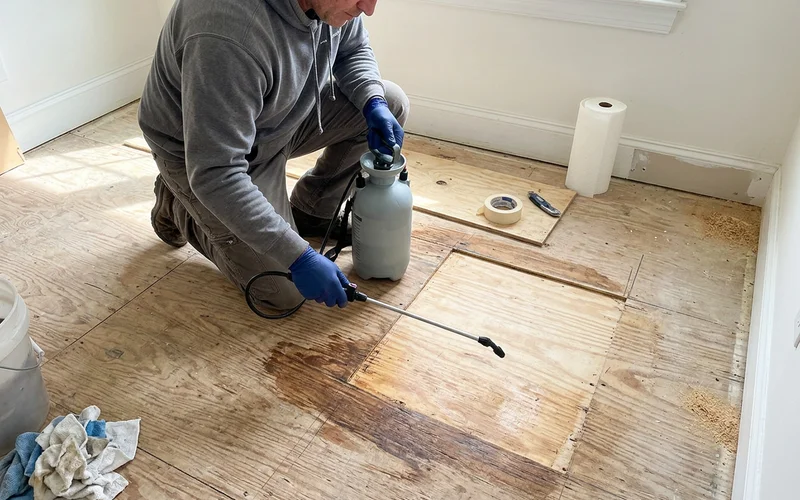
Skipping the seal is the most common shortcut in this industry, and it is why families call a second company three weeks later asking why the smell came back.
Step 6: Odor treatment
Only now does air treatment happen, because treating air over an unremediated source accomplishes nothing.
| Method | When we use it | Occupancy |
|---|---|---|
| Hydroxyl generator | Occupied properties, longer cycles | Safe with people present |
| Ozone chambering | Empty properties, aggressive treatment | Must be fully unoccupied |
| Thermal fogging | Deep penetration into porous surfaces | Unoccupied during application |
Advanced decomposition cases usually need whole-property treatment rather than room-level, because odor has already reached the rest of the structure and often the HVAC ductwork.
Step 7: Verification and handover
We verify surfaces with testing and confirm odor resolution before releasing the property. Both are documented.
Your closing file includes before photographs, itemized scope, disposal manifests, verification results, and after photographs, delivered through the secure Client Portal. That package serves three audiences: your insurance adjuster, an estate or probate attorney, and family members who were not able to be there.
What happens to belongings
Contaminated items are disposed of as regulated waste with a manifest. Salvageable items are set aside and logged.
If you want us to look for something specific, a wallet, documents, jewelry, or a phone, tell us before we begin and we will search for it first. That request is completely normal and nobody will find it strange.
For why odor is so persistent in these cases and what actually resolves it, our guide on why decomposition odor needs a specialist goes deeper into the material science of the problem.